
Skip to content
Trillion Digital
Login
Trillion Digital

Institutional-grade digital asset infrastructure for professional counterparties.

All systems operational

Products

  • Stablecoin Liquidity
  • Deliverable FX
  • Block Trading

Solutions

  • OTC Trading
  • Electronic Trading

Who We Serve

  • FinTechs
  • Banks
  • Exchanges
  • Corporates
  • Hedge Funds
  • Family Offices

Company

  • About Us
  • Manifesto
  • Insights
  • Careers
  • Contact
  • FAQ

Legal

  • Regulatory
  • Disclosures
  • AML/CTF Policy
  • Prohibited Activities
  • Prohibited Jurisdictions
  • UK Residents
  • GLB Privacy Notice

Resources

  • Referral Program
  • Brand Assets
  • System Status

Follow Us

Ask AI About Us

Ask your favorite AI assistant about Trillion Digital.

This material is provided for informational purposes only and does not constitute accounting, legal, tax, or investment advice. Any products, services, or features referenced herein are subject to the terms and conditions of their respective legal agreements and may not be available in all jurisdictions.

Trillion Capital Markets Inc. d/b/a Trillion Digital is registered as a Money Services Business with FinCEN (MSB Registration Number: 31000289656453) and holds a Money Transmitter License in the State of Florida (MTL License Number: FT230000409). Trillion Capital Markets Inc. is not registered or licensed with the U.S. Securities and Exchange Commission or the U.S. Commodity Futures Trading Commission. Our services are available only to eligible institutional clients, including qualified purchasers, high-net-worth individuals, qualified institutional buyers, and well-capitalized corporations, as defined under applicable law.

Trillion Capital Markets AG is a registered member of the VQF Financial Services Standards Association (VQF SRO Member No. 101081), a self-regulatory organization recognized by FINMA. As a member, Trillion Capital Markets AG complies with VQF's supervisory framework for anti-money laundering (AML) and counter-terrorism financing (CTF), pursuant to the Swiss Anti-Money Laundering Act and other applicable standards.

Trillion Capital Markets Limited and Trillion Capital Holdings Limited do not conduct, and do not purport to conduct, any virtual asset services within or from the Cayman Islands. Neither entity is registered, licensed, or authorised under the Cayman Islands Virtual Asset (Service Providers) Act (as revised) and neither entity provides any services that fall within the definition of "virtual asset services" under that Act.

For legal and compliance reasons, including adherence to OFAC sanctions, our services are not available to individuals or entities located, resident, or established in the following jurisdictions (among others): Afghanistan, Belarus, Burma (Myanmar), Côte D'Ivoire (Ivory Coast), Central African Republic, Democratic Republic of the Congo, Cuba, Iran, Iraq, Liberia, Libya, North Korea, Palestine (Gaza Strip), Russian Federation, Somalia, South Sudan, Sudan, Syria, Ukraine, Yemen, Zimbabwe, or to members/affiliates of the government of Venezuela.

© 2026 Trillion Capital Holdings Limited. All Rights Reserved.

Terms of ServiceWebsite TermsPrivacy PolicyCookies Policy
Back to Insights

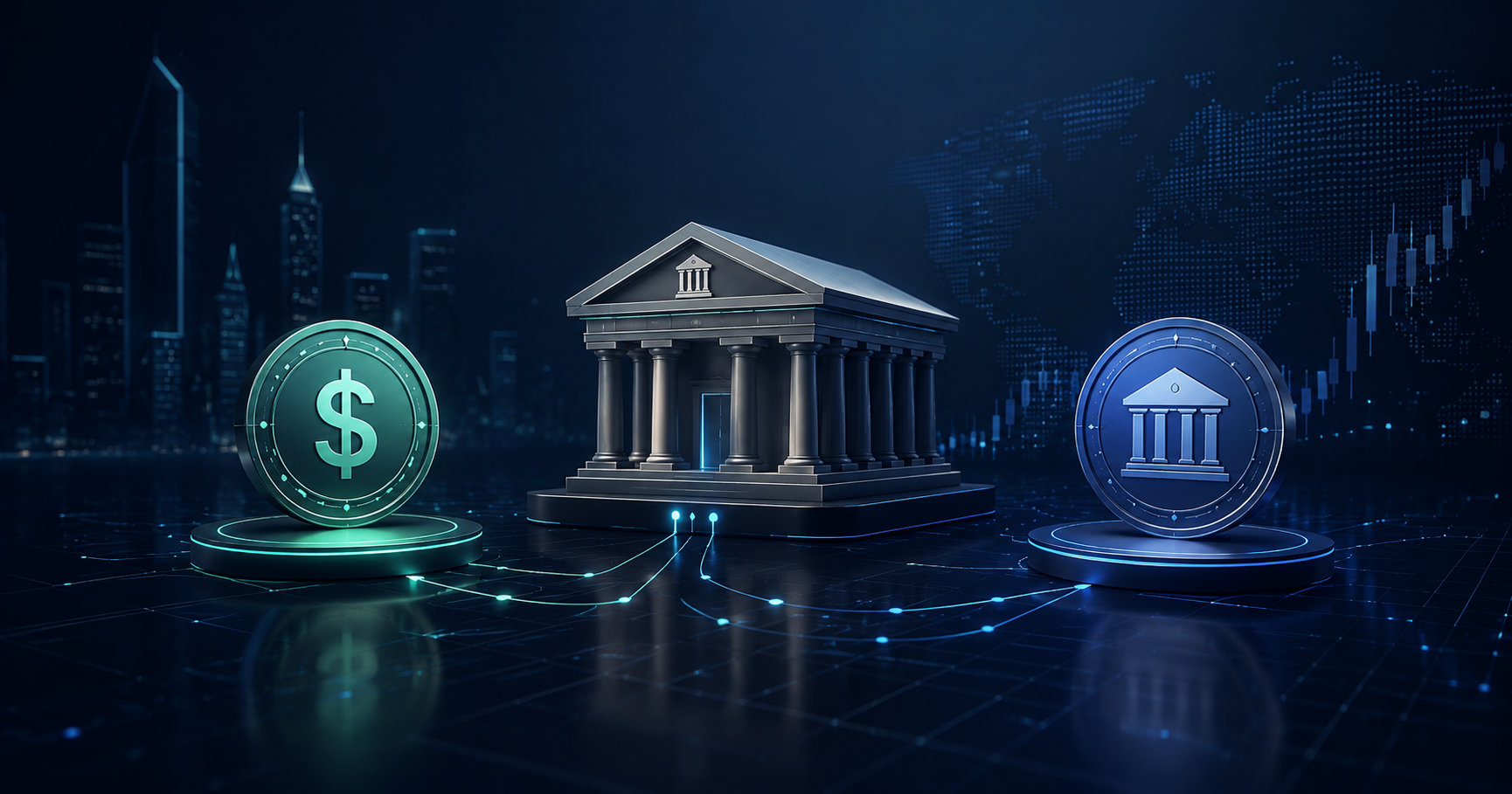
Stablecoins or Tokenized Deposits? Institutions May End Up Using Both
Press
September 1, 20263 min read
Stablecoins or Tokenized Deposits? Institutions May End Up Using Both

The debate over digital money is becoming more practical.

At the Jackson Hole Economic Symposium on August 28, BIS General Manager Pablo Hernández de Cos argued that stablecoins are not a credible foundation for payments at scale, pointing to concerns around interoperability, financial stability and monetary sovereignty. He highlighted tokenized commercial bank deposits as a more promising path.

At the same time, banks and central banks are actively exploring tokenized cash, deposits and blockchain-based settlement.

The question is no longer whether money will move onto programmable infrastructure.

It is what form that money will take.

Different instruments, different strengths

Stablecoins and tokenized deposits can both represent familiar currencies digitally, but they are not the same.

Stablecoins are separate instruments issued against reserve assets.

Tokenized deposits remain liabilities of commercial banks, represented on programmable infrastructure.

For regulated institutions, tokenized deposits may fit more naturally into existing banking frameworks.

Stablecoins, however, already have something tokenized deposits largely do not: scale, market liquidity and established use across digital-asset markets.

That makes a simple winner-takes-all outcome unlikely.

Institutions will choose based on utility

For treasury desks and trading firms, the decision will be practical.

They will care about:

  • liquidity;

  • settlement speed;

  • counterparty exposure;

  • operating hours;

  • regulatory treatment;

  • convertibility into other currencies.

At institutional size, those differences matter.

A digital asset can settle in seconds and still be inefficient if converting it into another form of money is expensive or operationally difficult.

Coexistence creates a new market problem

Stablecoins, tokenized deposits and traditional fiat are likely to coexist.

That means institutions may increasingly need to move between them.

A company receiving a dollar stablecoin may need euros.

A bank holding a tokenized dollar deposit may need to settle with a counterparty using another digital asset.

A business in the Gulf may receive digital dollars but ultimately need local currency in a bank account.

The transfer may be instant.

The conversion is not.

A market still has to exist between the two forms of money.

Liquidity may matter more than the winner

Much of the tokenization debate focuses on technical interoperability: whether different networks and ledgers can connect.

But financial interoperability requires something more.

It requires liquidity.

Two systems can be technically connected while remaining economically disconnected if institutions cannot efficiently exchange the assets that exist on them.

Stablecoins and tokenized deposits may therefore be less important as competing technologies than as parts of a broader financial network.

The next stage of digital settlement may not be defined by which instrument wins.

It may be defined by how easily institutions can move between them.

Share

Related Articles

Cover image for The Next Phase of Crypto Is About Infrastructure

The Next Phase of Crypto Is About Infrastructure

6 min read
Cover image for Institutions Are Coming Back to Crypto - But the Market Has Changed

Institutions Are Coming Back to Crypto - But the Market Has Changed

10 min read
Cover image for Why Best Execution in Crypto Is More Complicated Than It Looks

Why Best Execution in Crypto Is More Complicated Than It Looks

8 min read